
Broken Houses
winner of the L.E. Phillabaum Poetry Award for 2026
now available for pre-order
 In Broken Houses, her fourth collection of poetry, Chelsea Rathburn offers a powerful meditation on home and the foundations—both physical and metaphorical, stable and unstable—that shape us.
“It wasn’t breaking and entering, / my parents swore, if a door / was already open,” Rathburn writes of a childhood spent slipping into construction sites for “furtive tours” of half-built homes. For the young poet, ‘For sale’ signs, dollhouses, and model homes represent wonder and possibility. Over time, though, this early wonder gives way to an awareness of both class difference and how easily our houses can be destroyed—whether by natural disasters or human forces—and with them our sense of stability and self.
Drawing upon historical records, contemporary art, family photographs, and memory, Rathburn explores the settlement of the city of Miami, as well as her father’s placement in a California foster home, to tell larger stories of dispossession and erasure.
At a time when the American Dream seems all the more unreachable, the poems in Broken Houses urge us to hold tight to one another and build connections where we can.
Praise for Broken Houses
“Here is a book that makes me want to believe in ghosts.
Chelsea Rathburn is a medium in Broken Houses, able to traverse between the hauntings of both past and future, to summon an Otherworld between these pages. Rathburn digs down to the limestoned bedrock of a Florida childhood marked by negotiations of history, class, and family, to ask what—if anything—sprouts from such hard ground?
Across four books, Rathburn has proven herself one of the most astute poets of a generation—someone who is able to see clearly the invisible ties between the personal and political—who can juxtapose the large and violent narrative of John Sewell clearing a Tequesta burial mound against the small and quiet terror of a girl left to reckon with ghosts alone. Rathburn wrecks us open, and God, are we are better for the wounding.
A life-force of a book, if there is any answer to the question—what could be big enough to contain a life—this book might be that answer.”
—Diamond Forde, author of The Book of Alice
“This is profoundly precise poetry: There is never an errant word and the observations are keenly particular to their people and places. Yet the poems are like locksmiths that can open doors to anyone’s contemplations of brokenness, belonging, and beyond.
Rathburn has the power to demolish banal ideas about home and expose the unfillable gaps in what we can know of even our own families. She also has the grace to build back poems that are shelters for love and its artful expressions.”
—Rose McLarney, author of Colorfast
Still Life with Mother and Knife
winner of the 2020 Eric Hoffer Book Award in Poetry
 In her third collection, Still Life with Mother and Knife, Chelsea Rathburn seeks to voice matters once deemed unspeakable, from collisions between children and predators to the realities of postpartum depression. Still Life with Mother and Knife considers the female body, “mute and posable,” as object of both art and violence. Once an artist’s model, now a mother, Rathburn knows “how hard / it is to be held in the eyes of another.”
Intimate and fearless, her poems move in interlocking sections between the pleasures and dangers of childhood, between masterpieces of art and magazine centerfolds, and―in a gripping sequence in dialogue with Eugene Delacroix’s paintings and sketches of Medea (Delacroix’s Médée Furieuse is pictured at right)—between maternal love and rage. With singular vision and potent poetic form, Rathburn crafts a complex portrait of girlhood and motherhood from which it is impossible to look away.
Poems from the book have appeared or are forthcoming in the Missouri Review, Virginia Quarterly Review, the Southern Review, the Academy of American Poets’ Poem-a-Day, and other journals.
Still Life with Mother and Knife, a New York Times “New & Noteworthy” book, was released in February 2019 by Louisiana State University Press.
 Praise for Still Life with Mother and Knife
“‘For proof the world is frightening,/ look no further than the aggression/ of goats and chickens, and children, too,/ and even my own loathing, half-/understood,’ writes Rathburn in her arresting third book, a gentle whirlwind of memory, trauma, and uneasy hope, savored almost as much as it is run from. What do we do about, or with, the past if it hurts us? What if our most poignant memories, our most urgent questions, are about our worst moments? In mostly short, crystalline lyrics, Rathburn probes these and other unanswerable questions.”
—Craig Morgan Teicher, National Public Radio
“‘I Reject Walls’: A 2019 Poetry Preview”
“In Still Life with Mother and Knife, Chelsea Rathburn tells us that we inhabit our own fairy tales, and we have to learn to walk alone in the woods–the briary forests of adolescence, the dark drifts of motherhood, and then the lonely sands of old age. What is beauty? she asks. What is love? In her incandescent Introductions, she contemplates the many ways we discover the world with its chiaroscuro of good and evil, the known and unknown, love and hatred. A deeply felt chronicle of the passage from childhood into full womanhood.”
—Barbara Hamby
“Chelsea Rathburn is canny about so many things, the body, the small town, the structure of memory, the relationship between a mother and her child, and even the maternal feelings of Medea. Few poets can write with such frankness and good humor about their physical being and at the same time reveal their souls. Art, parenting, marriage, the imprint of memory, the violence that hovers in the background of American life, all are expressed in poems made so well that you will shake your head with admiration for their craft. Hers is an art of sanity and clarity and is more welcome now than ever.”
—Mark Jarman
ORDER STILL LIFE WITH MOTHER & KNIFE (AMAZON) ORDER STILL LIFE WITH MOTHER & KNIFE (INDIE)
A Raft of Grief
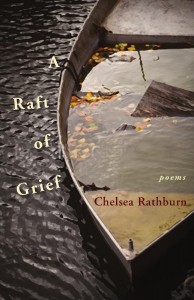 Praise for A Raft of Grief, selected by Stephen Dunn as winner of the 2012 Autumn House Poetry Prize
“In her excellent A Raft of Grief, Chelsea Rathburn probes the varieties and nuances of love and relationships with unsparing lucidity. “Maybe it’s not the eye/but the mind that can take only so much beauty, or solitude, or pleasure,/ maybe we travel both to find and forget ourselves,” she says in this book set in places as varied as Paris, Florida, Krakow.
“I love how she’s able to affirm what can happen between two people, while asking if a story-teller sometimes has to “sacrifice lovers and selves to the narrative arc?” She’s willing to, which is one reason why her narratives are so persuasive – her allegiance throughout is to the poem as a whole. She will not let her fine moments overwhelm, as lesser poets often do; her limpid, yet complicated phrasing is always part of the poem’s fabric.”
—Stephen Dunn
“Chelsea Rathburn’s canny, nervy poems play for keeps. She’s a poet of disarming intimations and unflinching reckonings, sparing no pains in parsing a meaning or probing a pang. Finely wrought and acutely felt, the bittersweet paeans and flinty laments in her new collection ace every acid test of lyric poise and resolve, bracing and beguiling in equal measures. Great hungers, little deaths, lost causes, a whole shifting cargo of ‘rages, lapses, and aches’ – for all the burdens in tow here, Rathburn’s resilient craft is a model of buoyant aplomb. A Raft of Grief is a superbly accomplished book from a poet who has truly arrived.”
— David Barber
“Chelsea Rathburn’s second book of poems, A Raft of Grief, bristles with rage, sorrow, poignancy and wit.”
— Lauren Watel
The Shifting Line

Praise for The Shifting Line, winner of the 2005 Richard Wilbur Award:
“The line in Chelsea Rathburn’s exceptionally fine and promising THE SHIFTING LINE is not only the line of love, traced unflinchingly through its lucid confusions and murky clarities, but also the deeply human pulse of feeling and forms – both metrical and amatory – composed from the dissonance of a fully lived life. A remarkable debut.”
– B.H. Fairchild
“First books by young poets are sometimes praised as showing great promise, and this one does; but in its distinctive marriage of form and feeling, The Shifting Line is also a remarkable accomplishment. I am happy to have read and reread these poems, and for the new readers who will discover their pleasures.”
– Catherine Tufariello